

Blog
AI Enablement
Hill Climbing with an LLM Judge
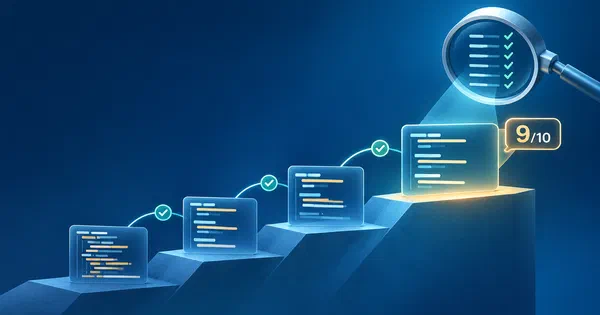
Agents climb fast against tests. For soft qualities like readable code, a blind LLM judge with a rubric gives them a hill to climb.
Read Article Arne Deutsch
12 min read
Holistic protection and seamless traceability for cybersecurity, functional safety, and the Cyber Resilience Act
Overview

Methodological excellence and tailored tools for model-based system and software engineering.
Overview

Enterprise software from a single source: AI integration, legacy migration and full-stack development — cost-efficiently and sovereignly hosted.
Overview

Done right, AI delivers real productivity gains: tasks that take hours today take minutes. The right tools, clean integration into existing processes, and actively making the people in your organisation co-designers make the difference. We bring the AI to your data.
A tool is licensed, a pilot kicked off, and a few weeks later the whole thing stalls. Nobody understood the underlying processes, the data did not fit, and the result ends up in a drawer.
The pilot runs on test data, and then it is time to work with real personal data. Suddenly it no longer works. Many providers deliver only a fragment and leave sovereign hosting to the customer.
AI introduced over the heads of employees fails at the acceptance stage. Efficiency on paper, friction in practice, because nobody involved the people.
AI Enablement means enabling an organisation to use AI independently and sustainably, as a permanent part of the way it works rather than in isolated instances. The term deliberately distances itself from two common misconceptions: it is neither a one-off coaching nor the pure sale of an AI licence.
The difference lies in the depth and in the duration. Coaching explains how a tool works and leaves the implementation to the customer. A tool sale delivers a licence and ends at the first real data-protection or integration problem. AI Enablement covers both, and goes beyond: we analyse the processes, actively shape the workflows, integrate the solution into the existing system landscape and accompany the customer until AI is strategically embedded in their business. In today’s fast-moving environment we monitor the market, keep toolchains and models up to date, and benchmark models against the customer’s use cases to optimise cost and benefit.
The decisive shift is in the role we take on. In the classic project world, users found someone to implement a defined system. In AI Enablement, we work with the customer to determine which system they actually need.
And it is not limited to software companies. The areas where AI delivers impact are the same ones in which we already work internally, and they often have nothing to do with software development: administration, analytics, support, controlling, triage in production. We sit down with the doctors, the architects or the specialist managers, analyse how they work, and automate with them the steps where AI creates real value.
We do not see ourselves as a coach who converts a manual workflow into an automated one once and then disappears, but as a partner for your long-term AI strategy.
For many organisations, data protection is the point at which AI initiatives fail. The use case is clear, the pilot runs on test data, and then comes the moment when real personal data is needed, and suddenly it no longer works. This is exactly where many providers deliver only a fragment: they provide the skill and the MCP and leave sovereign hosting to the customer. That helps no one.
Our principle reverses the usual logic: instead of sending your sensitive data to a foreign cloud AI, we bring the AI to where your data lives. In practice, depending on requirements, this means:
Local AI That Competes
When does a self-hosted open-weight model beat a frontier API? Christoph Hess describes five engineering levers, the conditions under which each one pays off, and a 90-day pilot plan with clear gates.
Perhaps the greatest benefit of modern AI is rarely stated: software can finally adapt to the needs of its users, rather than users having to adapt to the software. Anyone who buys an off-the-shelf tool (a CRM, a practice management system, any sector solution) has always had to adapt to what was built into the tool. Friction remains, because the user’s reality is more nuanced than any pre-built product.
With AI, this power shifts to the user. Non-technical employees often experience for the first time that they can build a tool that does exactly what they need: a precise solution containing exactly the right information.
An AI at the beginning is like a new employee fresh from university: a good degree, but not yet up to speed. You introduce it to the task, give it the context, and once that level of onboarding is reached, a brief instruction suffices: “Here is a new tender, get going” or “here is a new patient”, and the AI knows the whole process. In the past, the rational decision was almost always to buy a ready-made solution. As the cost of producing software has fallen sharply, the decision is shifting ever more towards building the perfectly fitting software yourself.
Introducing AI is not an unmanageable large-scale project but a structured, transparent process. We accompany you step by step:
1. Readiness and Use-Case Assessment
We jointly analyse your working practices, your system landscape and your data situation, and identify the use cases with the greatest leverage. The result is a clear target picture with measurable criteria, and an honest statement about where AI is worth it and where it is not.
2. Tool, Model and Architecture Tailoring
We select with you the right tools, frameworks and models, design the workflows with MCP, skills and agents, and address data protection, sovereign hosting and cost frameworks early, so that productive operation holds no nasty surprises.
3. Pilot with a Real Result
We implement a selected use case in production, so that something useful is in your hands at the end. Including the safeguards that productive operation requires.
4. Scaling and Roll-out
After the successful pilot, we extend the approach: to further use cases, areas and teams. Skills and workflows are organised (e.g. as plugins, versioned in GitHub or GitLab) so that individual solutions become a sustainable, maintained AI practice.
5. Long-Term Accompaniment and Independence
We remain your partner beyond the pilot, develop solutions further with you, and help your team take increasing ownership. The stated goal: that you use AI independently and productively, with us as a strategic partner in the background.
Trust also comes from stating what you do not do.
No “sell a licence and run”: Many providers set up a workflow and then disappear. We want to be the ones who support you long-term: developing your processes with you, embedding AI strategically in your business, and not leaving after the first delivered skill.
No one-off coaching: A training that explains and then ends leaves you alone at exactly the moment it gets serious: the step from test data to real data, from demo to operation. We actively co-design and stay until you can continue independently.
No AI theatre: We do not deploy AI just to deploy AI. If a use case brings no real benefit, we say so.
AI is not the answer everywhere. There are situations where we advise against it or recommend other groundwork first:
The efficiency-quality balance applies beyond software development too: trying out AI just because everyone does, and giving up at the first resistance, creates a graveyard of proof-of-concepts, but no value. The oft-cited 10× productivity gains are real, but they only materialise if done right: the right tools, cleanly integrated processes, and employees involved rather than bypassed.
Speak with Christoph Hess and Arne Deutsch about your specific use case. We jointly analyse where AI has the greatest leverage for you, and where it does not. Free of charge and without obligation.
Agents climb fast against tests. For soft qualities like readable code, a blind LLM judge with a rubric gives them a hill to climb.
Read Article
Arne Deutsch
12 min read
Compare systems, not models. Whether a self-hosted open-weight model holds up is decided by the context you assemble, the tools it can call, the checks it has to pass and the training data your workflow produces on its own. Christoph Hess sets out five engineering levers and the conditions under which each one pays off.
Download Whitepaper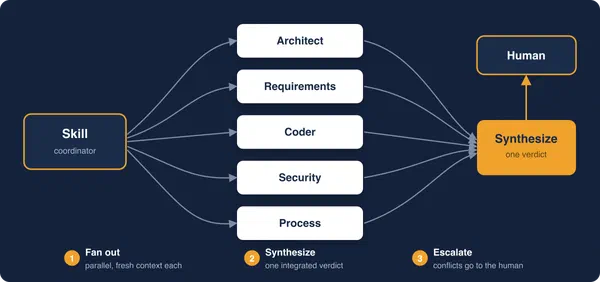
How to hand the bulk of software development to AI agents – and still get a result you can trust. A practitioner's look at vertical agents and horizontal skills for enterprise software teams.
Read Article
Arne Deutsch
8 min read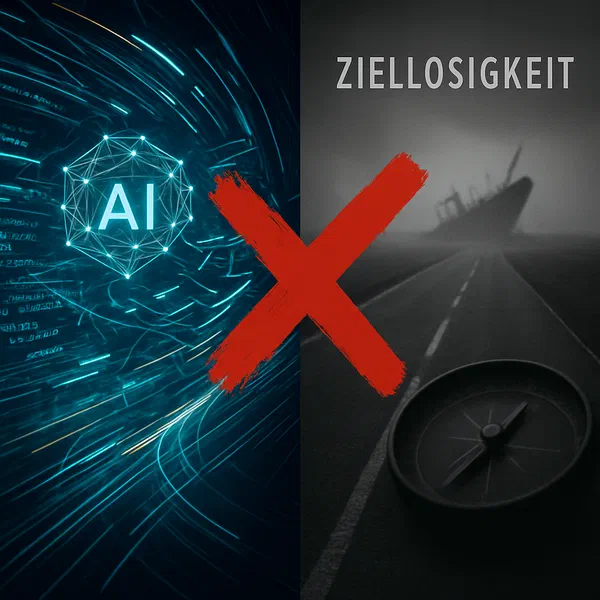
AI-driven development rarely fails because of the code – it fails because of aimlessness. Why technology is only half the battle and what really determines project success.
Read Article Holger Schill
4 min read
Find out how Artificial Intelligence is transforming the mobility industry – with practical examples from Deutsche Bahn and itemis experts.
Watch Webinar Christoph Hess